Growth Rate Adjusts in China; Coronavirus Panic Hits Manufacturing Industry Hard

After years of poor oversight, debt held by Chinese banks is growing at an unprecedented pace; defaults on corporate bonds have reached record numbers. Manufacturing and service indices are plummeting as a result of the impact of the coronavirus epidemic. Only 30 percent of small and medium enterprises are in operation. The prospect of economic stagnation is already a reality.
Read MoreThe Failure of Industrial Policy: India as a Case Study

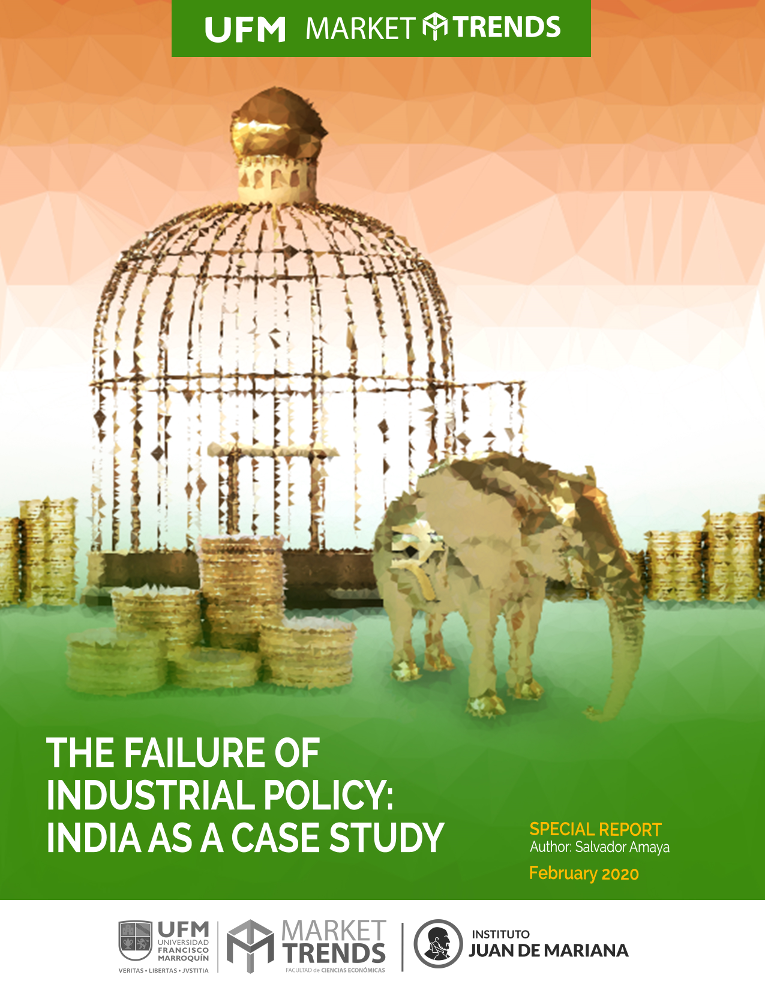
In this report, we study the 1991 liberalization of the Indian economy. We look at India’s socialist roots and how these suffocated economic growth and led India to a crisis that forced it to change its policies to allow international trade and investment and national capitalization and entrepreneurship. Then we consider how this type of policy should improve economic performance in theory, and we compare this with the concrete improvements in GDP per capita and in other important areas of the economy. Finally, we use the synthetic-control method to compare India’s performance with a synthetic version of India that did not liberalize. We conclude that these liberal policies can be credited for Indian income being 25.19 percent higher in 2001 than it would have been without liberalization.
Read MoreThe Current Slowdown Does Not Have to Lead to a Recession


The Spanish economy has deteriorated in recent quarters in the context of a less buoyant European and global economy. All indicators mark this slowdown, particularly the labor market, the real estate sector, and manufacturing. Financial markets declined earlier, and today they do not seem to be pricing in further economic deterioration, although different types of assets are performing differently. At the moment, it is premature to speak of a recession, given the lack of imbalances and excesses characteristic of all phases of unsustainable expansion prior to a recession.
Read MoreGuatemala´s Growth Shines Amidst a Central America with Economic Problems


The Guatemalan economy is, surprisingly, the fastest growing Central American economy. This is due to two causes. On the one hand, the economy recovers from its particular internal crisis. On the other hand, the public sector is spending in its last year of government all that it did not spend in the previous years, and is promoting sectors such as construction (sector also driven by the housing bubble that is developing in Guatemala City).
The global macroeconomic environment is complicated, and it does not help that Guatemala’s trade partners have problems. The US increases its risk of suffering a recession in the near future. On the other hand, all Central American countries are in clear slowdowns (the exception being Guatemala and El Salvador).
Forget the Trade War with the United States: China’s Growth Is Slowing in a Global Crisis
China’s real GDP growth in 2018 was 6.6 percent. The year began with an annualized growth rate of 6.4 percent in the first quarter. The low volatility in real GDP growth since the first quarter of 2015 (between 6.4 and 7 percent) has reinforced the need to look for alternative economic indicators that capture economic cycles in the Asian country. Public accounts are opaque in China. The Li Keqiang Index, capital-intensive consumption of energy, cyclical demand for consumer goods, and above all the manufacturing Purchasing Managers’ Index are indicating a slowdown in the growth of the Chinese economy, except in the real estate sector, which has not yet reached its peak.
Read MoreRecession Alert: The Question Is No Longer “If,” but When


An increasing number of warning signs are starting to appear in the U.S. Among other signs, the yield curve has inverted, which indicates — supplemented with other data — a recession is inevitable. At the very same time, the Fed appears to be losing control over its monetary policy. Why? Find the answer to this question and much more by downloading our most recent report on the U.S. economy.
Read MoreEconomic Impact of a Honduran Zone for Employment and Economic Development (ZEDE)
Honduras is far from being on track to become a developed country. At its current pace, it will take 160 years for Honduras to achieve a similar GDP per capita to that of the United States today. Yet there seems to be little hope for a top-down shift in policies and meaningful improvement of Honduras’s present-day institutions.
Nonetheless, the successful implementation of an SEZ could change this pessimistic outlook.
In this study, we attempt to estimate the (potential) impact of a successful ZEDE in Honduras on the material well-being of its citizens, as well as providing a list of policy recommendations to achieve a successful ZEDE. If implemented successfully, a ZEDE could empower a significant group of Hondurans and achieve meaningful GDP growth over the coming decades.
Read MoreThe Eurozone’s Economy Staggers


The global economic dynamic is becoming more complex. The trade war between the two great powers—China and the US—is affecting the growth of the rest of the world. The Eurozone is no exception. Despite maintaining solid fundamentals as a result of the recovery from the 2011 crisis, the Eurozone’s growth is not as optimistic as it was a few months ago.
The ECB’s target inflation of 2% was reached, although slightly, and core inflation remains weak. The ECB continues with tapering, despite fears of a slowdown. Credit has become more flexible due to greater interbank competition and a lower perception of risk.
At the beginning of the year the financial system abruptly gained liquidity as a result of a readjustment in the consolidated financial statements of the system in the form of short-term loans to financial institutions. Yet this liquidity movement was not supported by changes in the short and long-term bond differential or in changes in bank financing rates. There are no immediate risks to the financial system in this regard.
While the Irish financial system has basically stopped its support from the ECB, Spain and Italy maintain the same rates as a year ago, and Greece maintains the marked reduction it needed to get out of the bail-out. In addition, the fiscal deficit has practically disappeared due to the austerity policies in the Eurozone. However, new fears arise from the new Italian and Spanish governments and their focus on deficit budgets.
After the Current Slowdown, Should We Fear an Impending Recession?
The Spanish economy has deteriorated in recent quarters, in line with a less resilient European economy. Almost all the indicators show this deceleration, from GDP, to vehicle sales and construction permits, to the M1 monetary aggregate and the confidence of agents. The equity market seems to have already priced in the current economic deterioration, even the likelihood of a coming recession. But, for the moment, it is still premature to predict a recession since there have been none of the classic imbalances and excesses that usually come during an unsustainable expansion prior to a recession .
Read MoreChina’s Private Sector Strong Despite Overleveraged State-Owned Enterprises
The Chinese growth miracle will not come to an end anytime soon. Even though some indicators point to a slight slowdown in consumption growth, industrial activity, cyclical consumer demand growth and credit growth, the Chinese economy continues to grow at an astonishing rate. Moreover, increasingly less capital is fleeing the country and capital flight seems to have peaked in 2016.
Yet two important underlying risks are present and worsening. First, highly indebted state-owned enterprises are a source of potential instability. The Chinese government has begun to selectively default on such state-controlled businesses (especially by local governments). Second, the Chinese private sector, especially the shadow banking system, has been financing itself at an increasing rate with dollar-denominated debt. An appreciating U.S. dollar is therefore bad news for the Chinese banking system and jeopardizes future economic growth.
Read More